
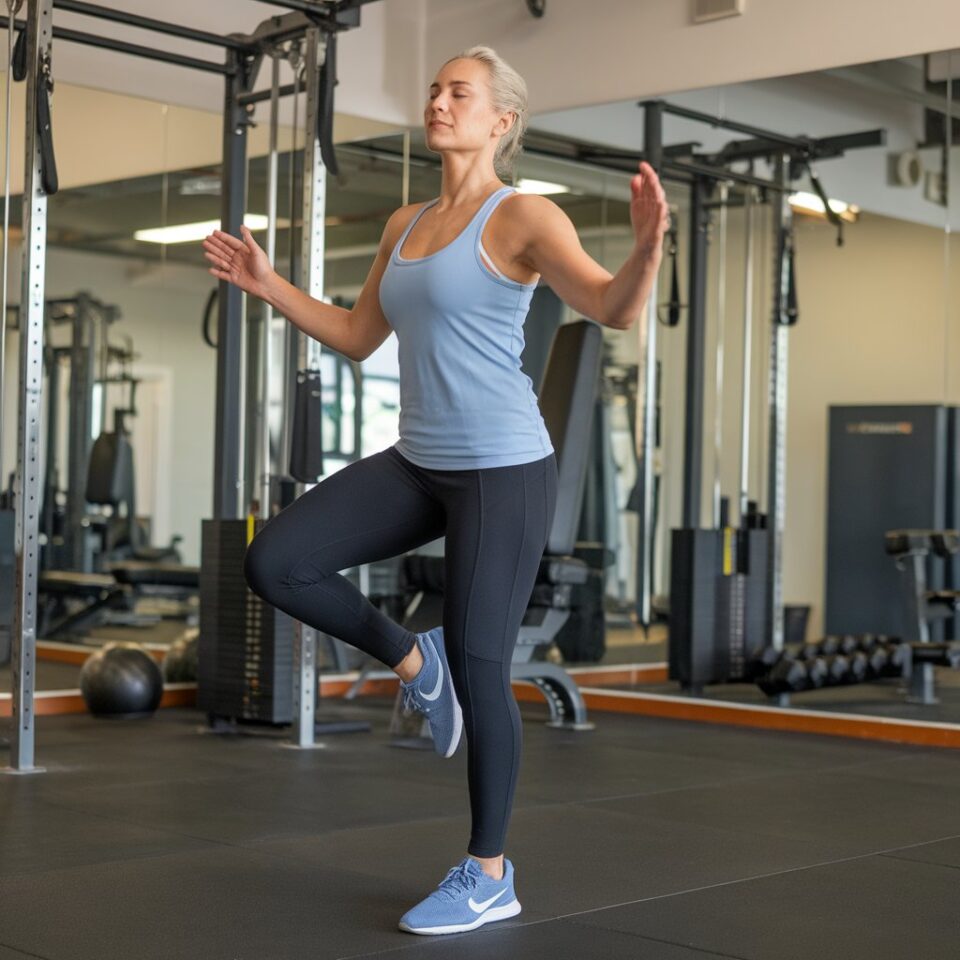
When people enter their forties, their fitness conversations usually pivot around a few predictable priorities: preserving joint cartilage, maintaining muscle mass, keeping cardiovascular metrics in check, and finding time for mobility work. These are worthy goals, but they routinely overlook the one physical attribute that quietly underpins every single movement you make: balance.
Most adults take balance for granted throughout their twenties and thirties. You step off a curb without looking, pivot sharply to catch a dropped cup, or navigate a root-strewn trail without giving the mechanics a second thought. Balance feels automatic because your neurological and muscular networks operate with seamless efficiency.
Right around age forty, that effortless synergy begins to erode. The decline is subtle at first. You might notice a momentary wobble when putting on socks while standing, or perhaps stepping off a ladder feels slightly less surefooted than it used to. Because these moments are fleeting, they are easy to dismiss as fatigue or distraction. In reality, they are early warning signals from a nervous system that is beginning to lose its fine-tuned spatial precision. Treating balance as an active skill rather than an assumed baseline is one of the most effective investments you can make in your long-term physical autonomy.
The Triad of Equilibrium: How Balance Actually Works
Equilibrium is not a single muscle group or a solitary reflex. It is an intricate, instantaneous calculation managed by three distinct sensory systems that feed real-time information to your brain stem and cerebellum.
The first system is visual input, which provides an external horizon and anchors your position in space relative to your surroundings. The second is the vestibular system, housed within the inner ear, which utilizes tiny fluid-filled canals and microscopic hair cells to detect linear acceleration, head tilt, and rotational motion. The third is the somatosensory and proprioceptive network, comprised of millions of specialized mechanoreceptors embedded in your joints, tendons, ligaments, and the soles of your feet. These receptors constantly report pressure shifts, joint angles, and surface textures.
Your brain processes these three inputs simultaneously, cross-references them, and fires off motor commands to your muscular system to adjust your center of mass over your base of support. When all three systems function at peak capacity, the adjustments happen in milliseconds without conscious thought.
The Subtle Physiological Shift in Your Forties
The human body does not wait until retirement age to begin slowing down its balance systems. Biological shifts that directly compromise stability accelerate in the fourth decade of life.
The somatosensory system undergoes a noticeable decline in receptor density and nerve conduction velocity. The soles of your feet become less sensitive to subtle changes in terrain, which creates a slight communication delay between your feet and your central nervous system. At the same time, the vestibular system experiences a natural attrition of sensory hair cells within the inner ear, meaning your brain receives slightly degraded data regarding head position and velocity.
When sensory inputs become fuzzier, the brain is forced to rely more heavily on vision to stay upright. This is why many adults in their forties suddenly struggle to maintain balance in a darkened hallway or lose stability the moment they close their eyes in the shower. You have not forgotten how to balance, but your primary sensory backup systems are running on reduced bandwidth.
Sarcopenia and the Loss of Reactive Strength
Sensory awareness is only half of the balance equation; the other half is physical execution. Detecting an off-balance moment does you little good if your muscles cannot generate the immediate torque required to correct it.
Age-related muscle loss, or sarcopenia, begins to pick up momentum after forty. More importantly, this loss disproportionately targets Type II fast-twitch muscle fibers. While slow-twitch fibers handle sustained, low-load tasks like standing and casual walking, fast-twitch fibers are responsible for explosive, high-velocity reactions.
When you trip on an uneven sidewalk, your brain does not call upon endurance fibers to save you. It demands an instant, forceful contraction from the fast-twitch fibers in your calves, anterior tibialis, hamstrings, and glutes to snap your foot forward and establish a new base of support. This reflex is known as a reactive stepping strategy.
As fast-twitch fiber volume wanes, your reaction time lengthens. A stumble that you could have corrected in your thirties with a quick, reflexive step can easily turn into a fall in your forties because the stabilizing muscles of the lower leg simply cannot produce force quickly enough to halt your forward momentum.
The Cognitive Drain of Compensatory Movement
There is also a profound neurological price to pay when physical balance degrades. In youth, balance is largely autonomic; it occurs below the level of conscious awareness, handled by subcortical structures in the brain.
As sensory inputs fade and muscular reaction times slow, your brain compensates by shifting the burden of balance up to the prefrontal cortex, the executive center responsible for conscious thought, planning, and focus. In practical terms, staying steady stops being purely automatic and starts consuming active cognitive bandwidth.
This creates a dangerous dynamic known as dual-task interference. If you are walking down an icy street while carrying groceries and talking on the phone, your prefrontal cortex must divide its attention between your conversation and keeping you upright. Because executive resources are finite, any unexpected distraction can cause a momentary lapse in your stability strategy, sharply increasing your risk of a sudden misstep.
Preserving Joints and Preventing Costly Injuries
People often associate balance-related falls exclusively with senior citizens suffering hip fractures, but the orthopedic consequences of poor balance in midlife are severe.
A sudden slip or awkward recovery in your forties rarely ends gently. When your stabilizer muscles fail to absorb unexpected force cleanly, that mechanical stress transfers directly into passive structures: knee menisci, hip labrums, ankle ligaments, and the intervertebral discs of your lower back. Many chronic back spasms and torn rotator cuffs trace back to an aggressive, uncoordinated attempt to catch oneself mid-stumble.
Furthermore, subtle balance deficits alter your baseline gait mechanics. When you lack confidence in your single-leg stability, you spend less time in the swing phase of walking and adopt a wider, more rigid stance. This compensatory pattern produces uneven joint loading, accelerating wear and tear on your knees and hips long before typical age-related joint deterioration would otherwise demand attention.
Designing an Effective Balance Routine
The encouraging reality of neuroplasticity is that your balance systems respond remarkably well to targeted stimulation. Balance is not a fixed trait; it is an adaptable motor skill that sharpens with consistent, progressive challenge.
Static Stability Foundations
Static drills form the foundation of balance training, retraining the proprioceptors in your ankles and feet to hold your center of mass steady over a fixed base.
Begin with simple single-leg stands. Stand tall on one foot with a slight, unlocked bend in the supporting knee. Avoid locking the joint, which allows your skeleton to bear the weight passively rather than forcing your stabilizing muscles to work. Aim for forty-five seconds of steady holding per side.
Once this feels comfortable, introduce sensory deprivation by closing your eyes. Without visual feedback, your brain must immediately calibrate using only your inner ear and the mechanoreceptors in your feet. You will instantly feel the muscles around your ankle and arch fire furiously to make micro-adjustments.
Dynamic Movement and Sensory Integration
Real life rarely challenges balance while you are standing perfectly still. You need drills that replicate unpredictable, moving environments.
Incorporate tandem walking, placing the heel of one foot directly against the toes of the other with each step, as if traversing an invisible tightrope. To challenge the vestibular system, perform this drill while turning your head deliberately from side to side or looking up and down. Moving your head forces your inner ear to navigate conflicting spatial data while your feet continue forward.
Integrate balance into your standard strength training. Swap seated exercises for standing variations, and replace bilateral movements with unilateral work. Single-leg Romanian deadlifts, Bulgarian split squats, and lunges with a pause at the bottom force your deep gluteal stabilizers, such as the gluteus medius, to prevent your pelvis from tipping laterally.
Reactive and Footwear Interventions
To sharpen fast-twitch muscle fibers, you must expose your nervous system to controlled velocity and mild unpredictability.
Simple lateral bounds, jumping sideways from one foot and sticking the landing on the other for a two-second freeze, teach your body to absorb kinetic force and stabilize immediately. You can also introduce unstable surfaces, like a balance foam pad or a folded towel, which forces the neuromuscular system to adapt to unpredictable terrain.
Finally, reconsider your footwear. Modern shoes often feature thick, cushioned soles with stiff arch supports and narrow toe boxes. While comfortable, these designs effectively place your feet in sensory deprivation chambers, muting the ground feedback that your nervous system relies upon. Spending time barefoot on natural textures, using toe spacers, or training in minimalist footwear helps reawaken the intrinsic muscles of the foot and sharpens the mechanical sensors that keep you grounded.
Making Balance a Non-Negotiable Priority
Midlife fitness cannot simply be a relentless pursuit of heavier weights or higher heart rates. True resilience demands an athletic foundation that keeps you functional, reactive, and upright in an unpredictable world.
Spending just five to ten minutes a day challenging your equilibrium pays outsized dividends. It preserves your fast-twitch reaction capacity, relieves cognitive strain, protects your joints from acute trauma, and builds a durable buffer of physical confidence. When you train your balance deliberately in your forties, you ensure that movement remains a source of freedom rather than caution for all the decades that follow.